Inside the Yard That Could Build Canada’s Submarine Fleet
The Hanwha Ocean shipyard in Geoje, South Korea covers 4.9 million square metres. It employs roughly 31,000 people, operates its own fire departments, hospitals, and daycare centres, and produces approximately 45 to 60 vessels per year.
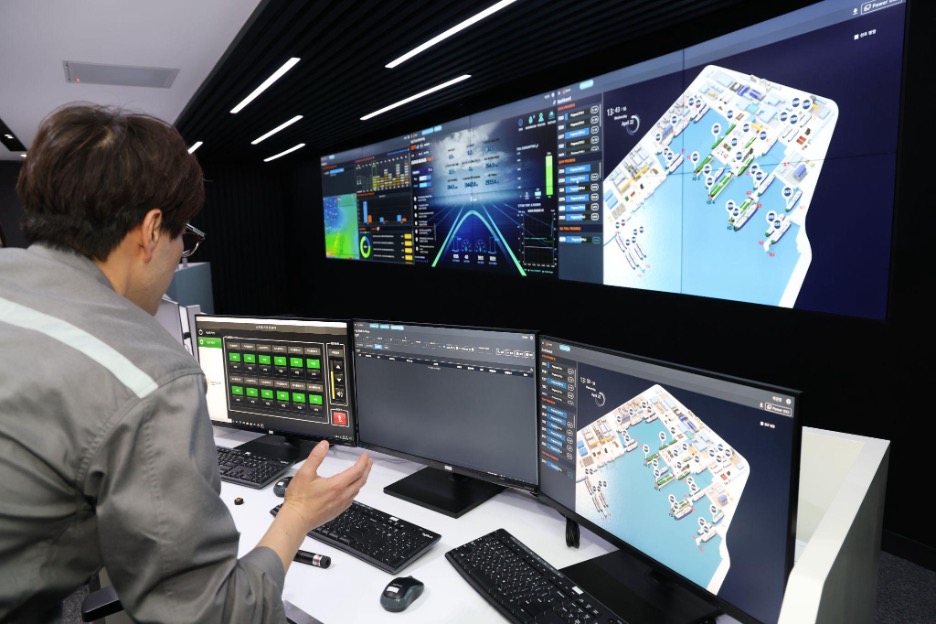
Vanguard visited the Geoje facility and Hanwha Ocean’s Siheung R&D campus in late April as part of an editorial trip hosted by Hanwha, gaining firsthand access to one of the production facilities under consideration for Canada’s submarine fleet renewal.
From explosives to ocean giants
Hanwha’s origins trace to 1952, the year before the Korean War armistice, when the company was founded as Korea Explosives Co. What followed over the next seven decades is one of the more remarkable industrial stories in modern history. Korea emerged from the war as one of the poorest nations on earth. Within a generation it had become one of the world’s dominant industrial powers, and shipbuilding was central to that transformation.
Today, South Korea accounts for roughly 25 percent of global shipbuilding output, with its three major yards, including Hanwha Ocean, leading the world in the most technically complex vessels: LNG carriers, naval combatants, and submarines. According to Hanwha Ocean, the company has delivered more than 1,400 vessels since 1973, including over 110 naval ships, making Geoje one of the most productive and experienced shipbuilding facilities in the world.
What world-class looks like
The first thing that strikes you at Geoje is not the size. It’s the calm.
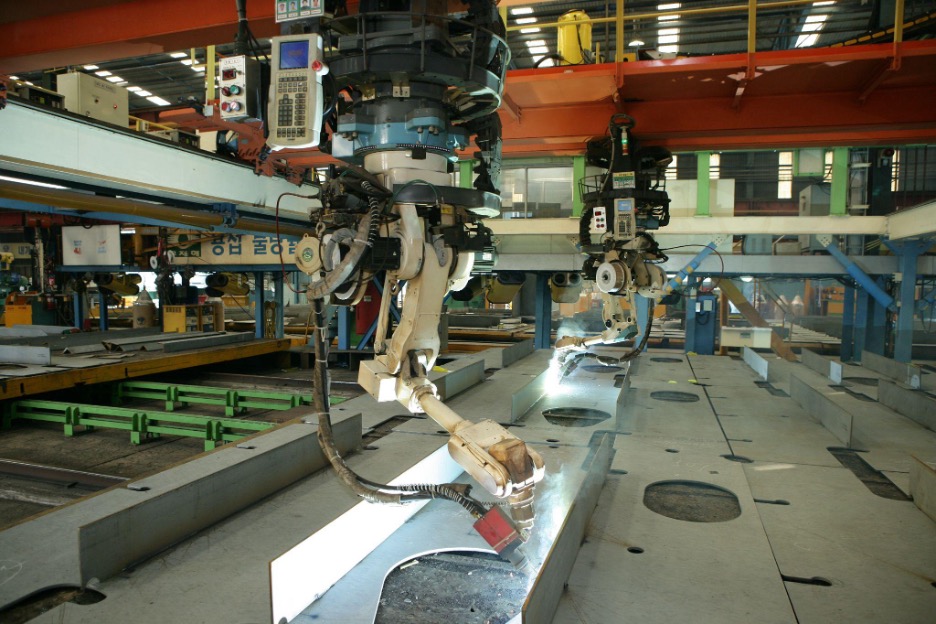
On a production floor building some of the largest and most complex vessels in the world, the operation runs quietly. Workers move with purpose. Drones patrol overhead, monitoring inventory flow, tracking parts, flagging bottlenecks before they develop. The automated welding lines are where the scale becomes tangible. DANDY, a fixed six-axis welding robot developed at the yard, moves along overhead gantry cranes handling single hull structures with a consistency and precision that defines modern Korean shipbuilding. Massive robotic systems work alongside skilled tradespeople throughout.
Two KSS III submarines were visible under construction during the visit, both larger than most people would expect.
According to Hanwha, the company has delivered more than 1,400 vessels without a recorded cost overrun passed to a customer. It is a claim that speaks as much to Korean shipbuilding culture as it does to Hanwha specifically. In Korea, a commitment to a date and a price is treated as non-negotiable. The production infrastructure, the workforce, and the established build drumbeat allow costs to be calculated with a precision that is difficult to achieve without all three in place simultaneously.
How Hanwha partners with allied nations
Hanwha’s approach to partner-nation contracts goes beyond equipment supply. When Hanwha won the contract to supply the Redback Infantry Fighting Vehicle to the Australian Army in 2023, it established the Hanwha Armoured vehicle Centre of Excellence in Geelong, Victoria, creating local manufacturing on Australian soil. Australian workers build Australian vehicles. Australian supply chains have developed around the program. It is an early program and the long-term results are still unfolding, but the commitment to local industry was genuine from the outset.
What Hanwha is proposing for Canada
The submarine Hanwha is proposing for Canada, the KSS III, is not a design concept or a paper proposal. The Republic of Korea Navy currently operates 21 submarines, making it the sixth largest submarine operating navy in the world. The KSS III entered service in 2021 and represents the platform around which Korea plans to grow and sustain a fleet of 27 submarines over the coming decades, replacing earlier smaller classes as it goes.
For Canada, the scale of Korea’s submarine program matters beyond the platform itself. Operating as part of a large and continuously evolving submarine fleet means access to a robust supply chain and shared lessons learned in operations and maintenance. It also addresses a long-standing concern in Canadian naval circles: the orphan fleet problem. Canada currently operates four Victoria-class submarines, the only four of their class in the world, carrying all obsolescence and sustainment costs alone.
Under its CPSP bid, Hanwha has proposed that submarines would be built at Geoje, with Canadian industrial benefits flowing through sustainment, maintenance, repair, and overhaul capacity on domestic soil over the fleet’s 30-year life. Canadian partners named in the proposal include Babcock Canada, Algoma Steel, and PCL Construction, among a growing list of companies spanning defence, manufacturing, construction, and technology, including firms focused on underwater warfare capabilities such as sonar, sensors, and torpedo support infrastructure, alongside a planned defence innovation centre intended to support collaborative R&D with Canadian universities and technology firms.
According to Glenn Copeland, CEO of Hanwha Canada, the company’s proposal includes $60 billion in economic opportunities for Canada and is projected to contribute $94 billion to Canada’s GDP between 2026 and 2044, supporting an average of 22,500 jobs annually. Those figures are drawn from a KPMG analysis commissioned by Hanwha.
In the weeks following the initial February 27 proposal submission, Hanwha continued announcing new Canadian partnerships, adding companies including AtkinsRéalis, Magellan, Boreal Energy, Geospectrum, Ultra Maritime, and several others, as well as agreements with the Government of Alberta, the University of Toronto, UNB, and Dalhousie.
On April 29, Hanwha announced a joint venture agreement with Canada’s Automotive Parts Manufacturers’ Association to establish a new Canadian entity that would produce military and industrial vehicles in Canada. The venture, contingent on Hanwha winning the CPSP, would create and sustain automotive sector jobs while establishing a domestic production capability for military and industrial vehicles using Canadian steel, aluminum, and parts.
Hanwha has also stated publicly that if awarded the contract this year, it can deliver four submarines to replace the current Victoria-class fleet before 2035, with the remaining eight following at a rate of one per year, completing a fleet of 12 by 2043.
What winning would mean for Hanwha
The CPSP is not simply another export contract for Hanwha. Winning would establish Korea as a credible submarine supplier to a Western NATO ally for the first time, potentially strengthening its position in allied defence markets that have historically been difficult to access. Canada, in this context, is as much a reference customer as it is a buyer. The industrial commitments Hanwha has made reflect an investment in that positioning that goes well beyond the value of the contract itself.
Beyond submarines, Copeland says the opportunities between Canada and Korea extend across multiple sectors. “Korea and Hanwha are committed to establishing a robust and long-term partnership with Canada and Canadian industry in several strategic areas, including energy, critical minerals, aerospace, space, shipbuilding, and advanced manufacturing,” he said, adding that the relationship supports the objectives of Canada’s Indo-Pacific Strategy.
The broader bilateral relationship is moving quickly regardless of the CPSP outcome. In February 2026, Canada and Korea held their second Foreign and Defence Ministerial Meeting in Ottawa, signing an Agreement on the Protection of Military and Defence Classified Information and initiating negotiations on a Defence Cooperation Agreement. On May 7, Prime Minister Carney spoke with President Lee Jae Myung, building on a Team Canada Trade Mission to Seoul the previous month. The leaders discussed deepening ties across trade, technology, and natural resources including LNG and critical minerals, and reaffirmed the Security and Defence Cooperation Partnership established between the two countries last October. The defence industrial relationship, of which the CPSP is the most visible expression, sits within a bilateral framework that both governments are actively expanding.
What comes next
Both Hanwha and TKMS submitted revised bids on April 29 after the government asked both competitors to strengthen their proposals. A decision from Ottawa is expected imminently.
What a visit to Geoje makes clear is that the production case is not in question. The yard exists, the submarines are being built, and the delivery commitments are grounded in a production operation that has operated at this scale for decades. What Canada weighs from here, the platform’s operational capabilities, the industrial benefits, the strategic partnerships, the alignment with allied relationships, and the long-term sovereignty considerations, are decisions that belong to Ottawa. The facility has made its case.
Vanguard visited Hanwha Ocean’s facilities in South Korea as guests of Hanwha in late April 2026.


Comments
Post a Comment