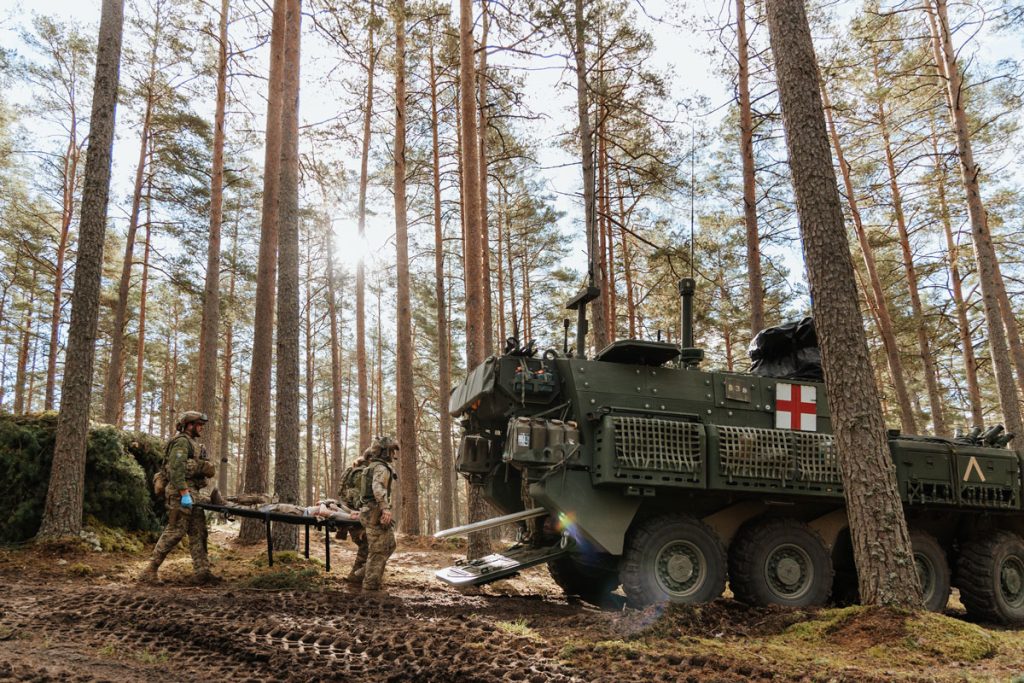
The Light Armoured Vehicle (LAV)
The Light Armoured Vehicle (LAV) is the backbone of Canada’s fighting vehicle fleet. The General Dynamics Land Systems-Canada (GDLS-Canada) LAV 6.0 family of vehicles remains a highly capable, protected, platform. It continues to evolve to meet emerging threats, incorporating new technologies and capabilities to ensure Canadian soldiers remain protected and effective on the modern battlefield.
Modern conflict is increasingly defined by what military leaders call the “fight for information.” Success on today’s battlefield depends on the ability to see first, understand faster, and act decisively. For Canadian soldiers, this means being trained and equipped to generate and sustain effects, and not only to move and fight, but to sense, process, and share information in real time.
Canada’s next generation of armoured combat vehicles will reflect this reality. Built on an open digital architecture and equipped with advanced sensors, these platforms will integrate data from uncrewed systems and multiple sources, enabling commanders to detect threats earlier, share critical information seamlessly, and maintain superior situational awareness in even the most complex operating environments. But technology alone is not enough. Equally important is where—and how—this capability is developed, built, and sustained.
Sovereign Capability
The government’s recent creation of a Defence Investment Agency intends to modernize and streamline Canada’s procurement system, tying procurement more strategically to domestic industrial benefits – creating new careers, growing the economy, and supercharging innovation. The goal is clear: reduce complexity, move faster, and provide Canadian industry with greater clarity and predictability—ensuring the Canadian Armed Forces (CAF) have the world-class equipment they need.
Building on this momentum, Canada launched the Defence Industrial Strategy (DIS) earlier this year. The strategy sets out a vision for a strong, resilient Canadian defence industry—one that delivers technological and operational advantage to the CAF and its allies, while driving economic growth, innovation, and job creation across the country.
Central to this idea is the DIS’s second pillar – the “Build, Partner, Buy” framework which focuses on fostering made-in-Canada solutions and reducing traditional reliance on foreign military equipment and the establishment of key sovereign capabilities. This is not simply an economic objective—it is an operational imperative.
Sovereign capability in defence delivers speed, flexibility, and strategic advantage. It strengthens Canada’s position among allies and, most importantly, secures control.
GDLS-Canada ensures Canada-focused approach to capability development and investment. When land armoured vehicles are designed and manufactured in Canada, decisions about upgrades, repairs, and modifications remain in Canadian hands. The intellectual property developed is Canadian. Capabilities can be adapted quickly to meet evolving threats, and systems can be tailored specifically to Canadian missions, geography, and operational requirements. Therefore, there is no dependency on foreign approvals for critical changes to the end-item platform.
This approach is not new. For nearly 50 years, GDLS-Canada has been designing, building, fielding and supporting LAVs in Canada, by Canadians, for Canadians.
Accelerating Defence Procurement
Delivering capability at the pace required by today’s security environment also demands a more agile and responsive procurement system.
GDLS-Canada’s long-standing relationship with the Government of Canada and the CAF provides a deep understanding of operational requirements, procurement processes, and the realities of delivering complex capability. This positions the company well to support the government’s evolving “Build–Partner–Buy” procurement model, which aims to increase domestic procurement to 70 percent.
This model reflects an approach GDLS-Canada has applied for decades. The company builds where it has core expertise, partners with Canadian and international industry to integrate leading technologies and procures externally where it makes sense. This balanced approach ensures both capability excellence and industrial strength.
However, sustaining this capability requires more than procurement reform—it requires stability.
The defence industry is highly specialized. Skills such as vehicle systems integration, survivability engineering, and ballistic welding cannot be developed overnight. These capabilities are built over decades and sustained through consistent demand.
When procurement cycles fluctuate dramatically—creating “boom and bust” conditions—these critical skills are at risk. Once lost, they are extremely difficult to rebuild. The result is not only industrial disruption, but potential risk to long-term operational readiness.
A more predictable demand signal, supported by long-term planning and closer alignment between government, the CAF, and industry, allows for collaboration in the sustainment of an enduring capability through investment in our workforce, infrastructure, and innovation. It ensures that Canada retains the specialized expertise required to design, build, and support advanced defence systems over time.
The Role of Exports in Sustaining Capability
Exports play a critical role in sustaining Canada’s defence industrial base. A strong export portfolio helps smooth demand cycles, reducing the risk of dramatic peaks and valleys in production while enabling Canadian defence companies to maintain a steady skilled workforce, invest in innovation, and keep production lines active between domestic programs.
This proven success over decades is built on a longstanding partnership between industry and the Government of Canada. Through advocacy, export support, and strong diplomatic engagement, the Government helps open doors to global markets and reinforces the credibility of Canadian capabilities abroad.
GDLS-Canada’s exports drive direct benefits at home. International customers often have unique requirements, creating opportunities to integrate new technologies, refine designs, and enhance capabilities. These advancements, in turn, come back to Canada—ensuring that the CAF receive platforms that are continually evolving and remain leading edge.
When we export, we bring our domestic suppliers with us—giving Canadian companies the opportunity to gain global exposure and grow alongside us.
Government support for export activity is therefore not only an economic enabler, but a strategic one. It strengthens Canada’s defence industrial base, enhances global partnerships, and reinforces Canada’s position as a reliable contributor to allied security.
Looking ahead, continued alignment between industry and government will be essential to compete globally, sustain sovereign capability, and ensure Canada remains at the forefront of defence innovation.
Strengthening Canada’s Defence Supply Chain
Another critical pillar of the Defence Industrial Strategy is the strengthening of domestic supply chains.
The strategy emphasizes that while Canada seeks to localize production and build domestic manufacturing strength, national security also depends on resilient supply chains—both within Canada and across trusted allied networks.
The notion of how critical it is to have a strong supply chain is not new, but it’s worth repeating. Our operation in London, Ontario, works with approximately 600 suppliers across the country, including Indigenous-owned businesses, forming a broad and diverse industrial ecosystem that supports vehicle production and sustainment.
These Canadian suppliers are not peripheral—they are integral to program success. They contribute specialized components, advanced technologies, and innovative solutions that enhance the performance and reliability of Canadian-built platforms.
A strong domestic supply chain also improves responsiveness. It enables faster turnaround for parts, maintenance, and upgrades, while reducing vulnerability to a global disruption.
Looking Ahead
As Canada looks to the future, the intersection of technology, sovereignty, and industrial capability will define its defence posture. Canada has the foundation that can support the execution of the DIS’ key pillars.
By continuing to invest in made-in-Canada solutions, strengthening domestic supply chains, supporting procurement reform, and renewing government – industry relationships, Canada can ensure that its armed forces are equipped with the capabilities they need—when they need them.
We remain committed to working with the Government of Canada and the CAF to provide sovereign capability for Canada that accelerates innovation, strengthens our defence industrial base, and delivers the capabilities our soldiers need.
A Light Armoured Vehicle contract in Canada…
- Strengthens the country’s economy
- Sustains over 13,400 jobs across Canada
- Sustains approximately 600 suppliers
- Impacts 100+ communities
- Develops and secures Canadian intellectual property
Export programs…
- Support Canadian innovation
- Keep production lines active between domestic programs
- Reduce the risk of dramatic peaks and valleys in production
- Maintain a steady skilled workforce between domestic programs


Comments
Post a Comment